

When we look at Kambo through a scientific lens, the tribal mystery takes the form of precise biochemistry.
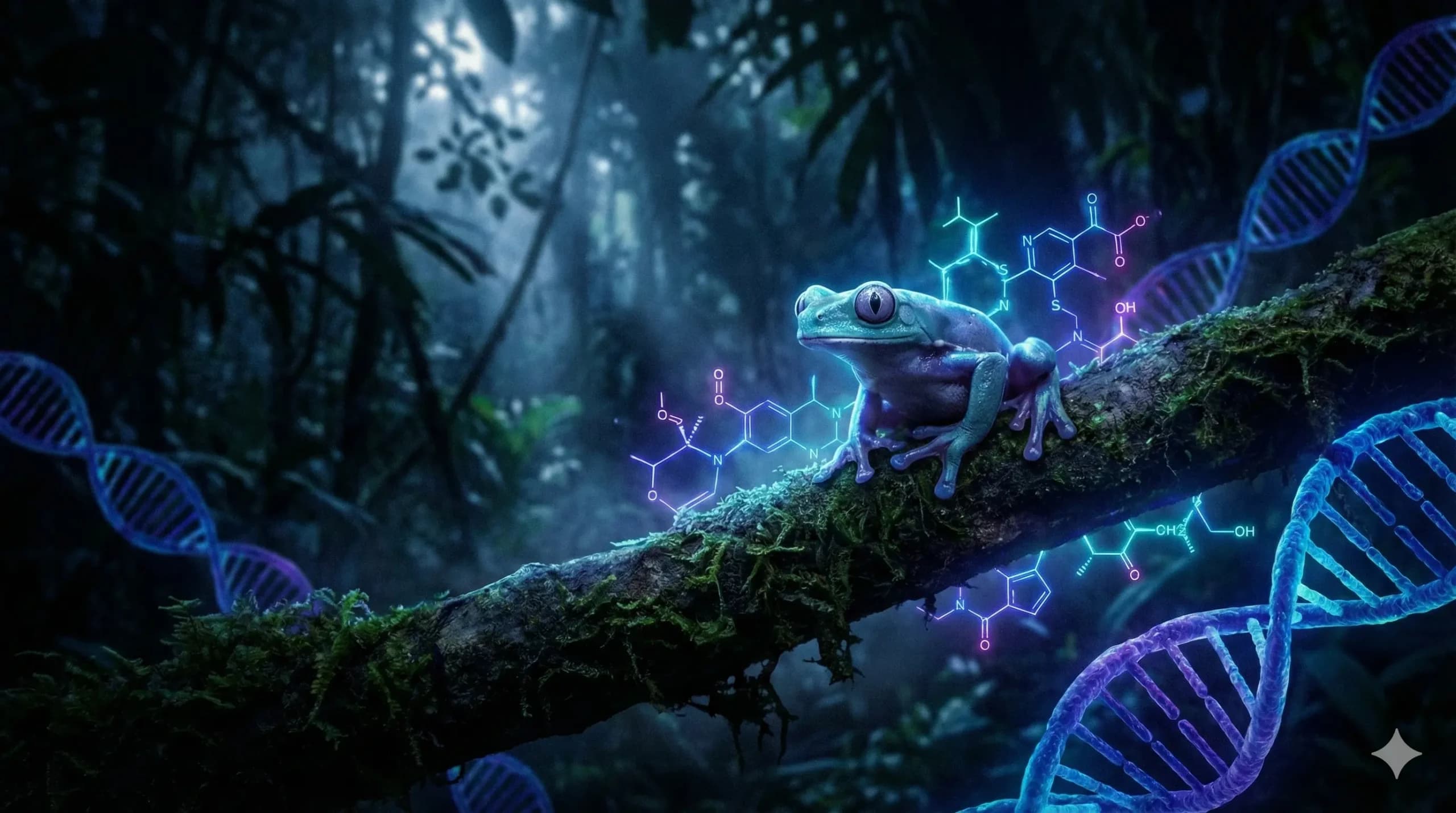
The secretion of the Phyllomedusa bicolor ("Giant Monkey Frog") is not a "poison" in the classic sense of cell destruction, nor merely a folk "medicine." It is a sophisticated genetic tool that contains a cocktail of dozens of active molecules.
To understand why Amazonian tribes (such as the Katukina and the Kaxinawá) have used it for centuries for physical and mental strengthening, and why modern science is showing growing interest, we must start from the most fundamental unit of biological communication.
What Are Peptides, Exactly?
Before we dive into the complex names and understand the chemistry of Kambo, we need to understand the basics. A peptide is a short chain of amino acids — the building blocks of proteins. If we think of a protein as a long, unwieldy metal chain, then a peptide is a small, compact, and agile link (typically 5 to 50 amino acids).
Why does size matter? The tiny size allows Kambo's peptides to be absorbed at peak speed through the lymphatic system and bloodstream (especially when introduced through the skin), reaching deep tissues that larger proteins struggle to penetrate. Their action in the body resembles a lock-and-key mechanism: the cells in our body are covered with receptors (Receptors = locks). Each peptide in Kambo is a unique key fitted to a specific receptor. The moment the key turns, the cell receives an immediate command: to relieve pain, secrete a hormone, or attack a bacterium.
The Three Main Families: Kambo's Pharmacological Profile
Scientific research has identified over 28 different peptides in Kambo. They can be divided into three main action groups that alter human physiology:
1. Nature's Most Powerful Painkillers (The Opioid Family)
In this group we find Dermorphin and Deltorphin. These are peptides that bind to opioid receptors in the brain (Mu-Opioid Receptors), but with an intensity that is difficult to grasp in ordinary terms.
- Potency data: Comparative studies showed that Dermorphin is 30 to 40 times more potent than morphine, and in certain assays (depending on tissue type) potency of up to 2,170 times has been measured.
- The critical difference: Unlike synthetic opioid drugs, these peptides do not suppress the respiratory system in the same lethal manner, and they break down in the body relatively quickly.
- Cutting-edge research: In 2023, a synthetic derivative of Dermorphin called DALDA was studied for treating neuropathic pain (nerve pain caused by chemotherapy), showing promising results in rats without the severe side effects of conventional drugs.
2. The Warriors: Smart Antibiotics (Dermaseptins)
The Dermaseptin family functions as the frog's defense system against infections.
- Mechanism of action: These peptides act as "tiny soldiers" that identify bacteria, fungi, and parasites, and shred their cell walls. Because they attack the entire membrane rather than a specific internal mechanism, it is extremely difficult for bacteria to develop resistance against them.
- Proven efficacy (In Vitro): Studies demonstrated effectiveness against resistant bacteria (such as MRSA), Candida fungi, and tropical parasites (such as Leishmania).
- Oncological potential: Specific peptides like Adenoregulin and Dermaseptin-B2 showed in laboratory settings the ability to cause necrosis (cell death) in certain cancer cells (primarily prostate cancer), although human research has not yet matured.
3. The Purification Engine (Vasoactive Peptides)
The physical and emotional "cleansing" sensation in Kambo is no accident — it is the result of chemistry:
- Sauvagine: A peptide that mimics the body's CRF hormone, affects the pituitary gland, and triggers stress hormone release. It contributes to the feeling of "alertness" and focus that arrives after the ceremony.
- Phyllocaerulein: Causes smooth muscle contraction in the digestive system and gallbladder. This is the direct cause of the purging and rapid emptying process.
- Phyllomedusin & Phyllokinin: Powerful vasodilators. These are responsible for the sensation of heat, flushing, and the blood pressure changes that enable increased blood flow to internal organs.
The Reality on the Ground: What Do the Numbers Say?
While science studies individual molecules, Kambo is used in its "raw" form (full secretion).
A comprehensive survey study conducted in Germany and published in 2021 (Majić et al.) among 386 users revealed a fascinating picture:
- 87.31% of users reported improvement in general health or life satisfaction.
- 64.26% described the experience as having deep spiritual significance.
- 31.87% reported a decrease in depressive symptoms.
Expected side effects: 86% experienced purging (an inherent part of the process), and 73% felt intense heat. Only a tiny percentage (approximately 2%) reported lasting negative effects, indicating a reasonable safety profile with proper use.
Critical Safety Warning: The SIADH Mechanism
Understanding Kambo's chemistry saves lives. The peptide Sauvagine causes the body to secrete antidiuretic hormone (ADH). The implication: the kidneys temporarily stop filtering water.
The greatest danger in Kambo is not the "venom" itself, but excessive water consumption. If a participant drinks large quantities of water (over 3-4 liters) while their kidneys are "locked," a dangerous dilution of blood salts (hyponatremia) occurs. Of the 11 severe medical cases documented in the literature (including a single death of a 42-year-old man who used Kambo chronically), the vast majority were related to electrolyte imbalance and uncontrolled fluid intake, not direct peptide toxicity.
Summary: The Scientific Future of Kambo
Kambo stands precisely on the border between ancient tradition and medical innovation. While there are no clinical trials (RCTs) yet on the use of the raw secretion in humans, the isolated peptides within it present enormous potential for developing the next generation of antibiotics and non-addictive painkillers.
Until then, its use requires respect for the powerful biological mechanism it activates — knowledge is the key to safe and beneficial use. Understanding the chemistry of Kambo helps us refine our work here further and further.
You're welcome to read more about who Kambo treatment may be right for.
FAQ
Kambo is composed of peptides — short, tiny chains of amino acids. Unlike large proteins, their compact size allows them to be absorbed at peak speed through the lymphatic system and bloodstream, going straight to the receptors on cells.
Although the Dermorphin peptide is tens of times more potent than morphine, the peptides in Kambo do not suppress the respiratory system in a lethal manner like synthetic opioid drugs, and they tend to break down in the body relatively quickly.
The greatest danger is not the "reaction" itself, but excessive water consumption (hyponatremia). One of the peptides in Kambo temporarily stops water filtration in the kidneys, so overloading with water beyond what is needed (over 3-4 liters) can dangerously dilute the salts in the blood.
Sources and Research on the Chemistry of Kambo
- Majić, T. et al. (2021). Connected to the spirit of the frog. Journal of Psychopharmacology. Read >>
- Negri, L., et al. (1992). Dermorphin-related peptides from the skin of Phyllomedusa bicolor. Proc. Natl. Acad. Sci. USA. Read >>
- Sacco, M. A., et al. (2022). Kambo: Natural drug or potential toxic agent? Toxicol. Rep. Read >>
- Nogueira, T. A. C., et al. (2022). The Amazonian kambô frog Phyllomedusa bicolor. Frontiers in Pharmacology. Read >>
- Perumov, D., et al. (2023). Peripheral mu-opioid receptor activation by dermorphin. Nature Protocols. Read >>
- Batista-Junior, E. L., et al. (2024). Evaluation of antibacterial activity of new dermaseptin analogues. Molecules. Read >>
- Gomes, C. S., et al. (2022). Enhanced antibacterial activity of dermaseptin through nanoparticle formulation. Antibiotics. Read >>
- Haddad, V. Jr., & Martins, I. A. (2020). KAMBÔ: an Amazonian enigma. J. Venom Res. Read >>
- Hesselink, J. M. K. (2018). Rediscovery of old drugs: Dermorphin for postoperative pain. Journal of Pain Research. Read >>